Procure-to-Pay Automation with AI: GCC Finance Guide

Procure-to-pay (P2P) automation with AI means using software robots and AI to run the steps between a purchase request and a supplier payment: requisition, PO, receipt, invoice capture, matching, approval and payment. RPA handles the fixed, rule-based steps. AI reads documents, resolves exceptions and predicts what needs a human.

Procure-to-Pay Automation with AI: A Practical Guide for GCC Finance Teams
Key takeaways
- Procure-to-pay automation uses RPA for fixed, rule-based steps and AI for documents, exceptions and judgement. Most programmes need both.
- The quickest returns usually sit in invoice capture and match exceptions.
- Oracle Fusion already automates much of P2P natively. A partner fills the gaps: integrations, local VAT and e-invoicing rules, and process redesign.
- With UAE e-invoicing going live from January 2027, plan AP automation and e-invoicing as one programme.
What is procure-to-pay automation with AI?
For most GCC finance teams, the slow part of P2P is not the ERP. It is the work around it: invoices arriving as PDFs in shared mailboxes, buyers re-keying supplier quotes, AP clerks chasing approvers, and month-end spent clearing match exceptions.
This guide shows where automating the procure to pay process pays off first, what Oracle Fusion already does natively, where RPA and AI each fit, and a practical roadmap for UAE and KSA finance teams.
Why GCC finance teams are automating P2P now
Three pressures are landing on GCC finance teams at the same time.
- Structured e-invoicing is arriving. Saudi Arabia's ZATCA Phase 2 already requires integrated, structured invoices. In the UAE, businesses with annual revenue of AED 50 million or more must appoint an Accredited Service Provider by 30 October 2026 and go live on 1 January 2027; businesses below that threshold follow on 1 July 2027 (KPMG). Once invoices arrive as structured data, manual re-keying in AP stops making sense.
- Oracle is moving AI into the transaction itself. Oracle has added AI agents to Fusion procurement, including one that turns emailed supplier quotes into purchase requisitions (Oracle, Oct 2025), and in March 2026 announced 22 agentic applications across finance, HR, supply chain and CX (TechRadar).
- Finance headcount isn't growing with transaction volume. Multi-entity groups across the UAE, KSA and wider GCC handle more suppliers, currencies and VAT rules every year, and the AP team is expected to close faster, not hire more.
The result: P2P is where automation gives finance the quickest, most measurable win.
Which procure-to-pay steps can you automate?
Almost every P2P step can be automated in part; the highest returns usually sit in invoice capture, matching and exception handling.
| P2P step | Typical manual pain | What RPA does | What AI adds |
|---|---|---|---|
| Requisition | Requests by email or Excel, re-keyed by buyers | Creates requisitions from structured forms | Reads emailed quotes and drafts the requisition |
| Sourcing and PO | Comparing supplier quotes by hand | Generates POs from approved requisitions | Compares quotes on price, lead time and compliance |
| Approval | Approvers chased by email and phone | Routes by fixed rules and sends reminders | Flags unusual spend before it is approved |
| Goods receipt | Late receipts block invoice matching | Prompts receivers and posts receipts from scanned GRNs | Predicts which open POs will block matching |
| Invoice capture | PDFs in shared mailboxes, typed into the ERP | Moves files from mailboxes into the ERP | Extracts header and line data, learns supplier layouts |
| 2- and 3-way match | Price and quantity mismatches cleared by hand | Applies tolerance rules | Suggests the likely cause and fix for each exception |
| Payment and reconciliation | Manual payment runs and bank reconciliation | Prepares payment files and matches statements | Recommends payment timing and flags duplicate invoices |
| Supplier queries | "Where is my payment?" emails | Answers status queries from ERP data | Handles free-text queries in English and Arabic |
Start where volume and errors are highest. For most AP teams, that is invoice capture and match exceptions.
RPA vs AI in accounts payable and procurement
Use RPA for steps that follow fixed rules on structured data. Use AI where the input is unstructured or the decision needs judgement. Most P2P programmes need both.
Robotic process automation in accounts payable works well for moving files, posting approved invoices, preparing payment runs and sending reminders. It is fast to deploy, but it breaks when an invoice layout or a screen changes.
Robotic process automation in procurement suits PO creation from approved requisitions, supplier master updates and order confirmations. It cannot judge whether a quote is good value.
AI reads invoices and quotes in different layouts and languages, learns from corrections, classifies exceptions and predicts problems such as duplicate invoices or late receipts. It needs clean master data and a human review step for low-confidence results.
A practical rule for accounts payable process automation: let AI turn documents into data, let rules and RPA move that data through the process, and keep people for exceptions and supplier relationships.
P2P automation in Oracle Fusion: native features vs partner work
Oracle Fusion already automates much of P2P out of the box. The partner's job is to switch those features on properly, connect what sits outside Fusion, and fill the GCC-specific gaps.
What Oracle Fusion offers natively:
- Intelligent Document Recognition (IDR) in Payables reads emailed invoices (PDF, TIFF, PNG, JPEG, DOC, DOCX), creates invoices and learns from user corrections, including supplier layouts and logos (Oracle).
- Procurement AI agents, such as the Quote to Purchase Requisition Assistant and the Product Comparison Advisor (Oracle).
- Standard P2P controls: approval workflows, matching tolerances and payment processing.
Where GCC teams usually need a partner:
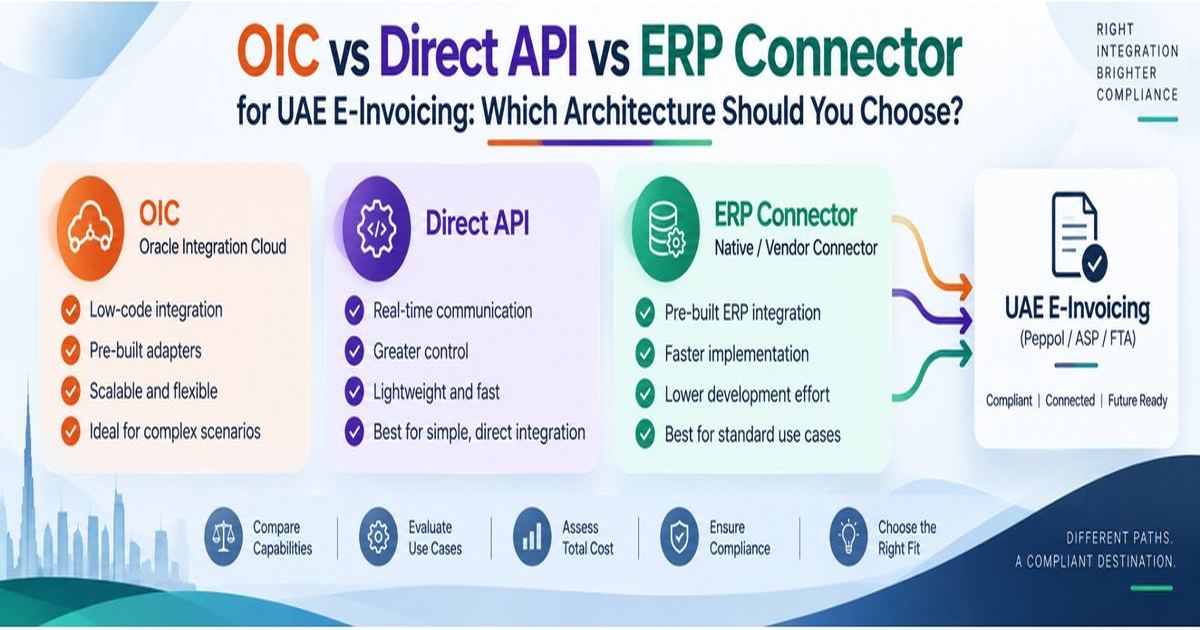
- Integrations with supplier portals, banks, legacy systems and e-invoicing service providers, typically through Oracle Integration Cloud.
- Documents IDR handles less well, such as poor scans, mixed-language invoices and non-standard formats, where a dedicated AI capture layer helps.
- Local rules: UAE and KSA VAT treatment, ZATCA and UAE e-invoicing flows, and multi-entity, multi-currency setups.
- Process redesign: automation built on a messy process just makes the mess faster.
Need inbound e-invoices to land in Payables too? See our guide to inbound UAE e-invoicing into Oracle Fusion Payables.
How to automate the procure-to-pay process: a 6-step roadmap
[IMAGE: p2p_automation_roadmap_oracle_fusion.png]
- Map the current process and baseline it. Document how requests, POs, receipts and invoices actually flow, including email and Excel workarounds. Record invoice volume, cycle time, exception rate and cost per invoice before you change anything.
- Fix master data first. Clean supplier records (TRN/VAT numbers, bank details, payment terms), item and category data. AI matching and recognition are only as good as the supplier master behind them.
- Switch on what Oracle Fusion already offers. Configure IDR, approval rules and match tolerances before buying anything new. Many teams find native features are licensed but unused.
- Automate the highest-volume pain point. Usually invoice capture plus match exceptions. Run a pilot on a few high-volume suppliers or one entity, with a human review queue for low-confidence results.
- Connect the edges. Integrate supplier portals, email inboxes, banks and your e-invoicing provider so data enters Fusion once, without re-keying.
- Scale, measure and add AI agents. Roll out across entities, track the KPIs below monthly, then add agents for quote intake, supplier queries and spend anomalies.
Most teams see the first measurable results from step 4. Steps 5 and 6 decide whether the gains last.
KPIs to measure P2P automation ROI
Track these from your baseline, monthly, per entity:
| KPI | What it shows | How to measure |
|---|---|---|
| Invoice cycle time | Days from invoice receipt to approval-ready | Receipt date to final approval date in Payables |
| Touchless (straight-through) rate | Share of invoices processed with no manual touch | Invoices with no edits or holds ÷ total invoices |
| Exception rate | Share of invoices on match or price holds | Invoices with holds ÷ total invoices |
| Cost per invoice | Fully loaded AP cost per invoice | AP team cost + tools ÷ invoices processed |
| Early-payment discounts captured | Cash benefit from paying on time | Discounts taken ÷ discounts offered |
| Duplicate and late payments | Control quality | Count and value per month |
| PO compliance | Spend going through approved POs | PO-backed spend ÷ total spend |
Use the touchless rate as the headline number for the CFO. It moves fastest when automation is working, and it explains most of the change in cost per invoice.
Common pitfalls to avoid
- Automating a broken process. If half your spend has no PO, a matching bot only automates the exceptions. Fix PO compliance first.
- Ignoring supplier master data. Wrong TRNs, duplicate suppliers and outdated bank details cause most recognition and payment errors.
- Bolting RPA onto screens. Bots that click through ERP screens break with every Oracle quarterly update. Use APIs and Oracle Integration Cloud where you can.
- No human-in-the-loop design. AI needs a clear review queue and confidence thresholds, especially in the first months.
- Treating e-invoicing as a separate project. In the UAE and KSA, structured e-invoices and AP automation share the same data and the same Payables flow. Plan them together.
- Measuring nothing. Without a baseline, you cannot prove ROI or decide what to automate next.
Frequently asked questions
What is procure-to-pay automation?
It is the use of software, RPA and AI to run the steps from purchase request to supplier payment with less manual work: requisitions, POs, receipts, invoice capture, matching, approvals and payments.
How is AI used in accounts payable?
AI reads invoices in any layout, extracts header and line data, matches invoices to POs and receipts, flags duplicates and suggests fixes for exceptions. It learns from each correction a user makes.
What is the difference between RPA and AI in procurement?
RPA follows fixed rules on structured data, such as creating a PO from an approved requisition. AI handles unstructured inputs and judgement, such as reading an emailed quote or comparing suppliers.
Can Oracle Fusion automate invoice processing on its own?
Partly. Oracle Fusion Payables includes Intelligent Document Recognition, which creates invoices from emailed documents and learns from corrections. Most GCC teams still need integrations, data clean-up and local VAT and e-invoicing setup to reach high touchless rates.
How long does it take to automate the procure-to-pay process?
It depends on scope. A focused pilot on invoice capture for one entity can run in weeks; a multi-entity rollout with integrations takes longer. Treat the timeline as an outcome of your assessment, not a fixed promise.
Does P2P automation help with UAE e-invoicing and ZATCA?
Yes. Structured e-invoices remove manual capture, and the same Payables flow, master data and integrations support both automation and compliance. Plan them as one programme.
Which KPIs prove P2P automation ROI?
Touchless rate, invoice cycle time, exception rate, cost per invoice, early-payment discounts captured and PO compliance, all measured against a pre-automation baseline.
How Innovage Cloud helps
Innovage Cloud is an Oracle Partner, ISO 27001:2022 certified, with offices in Dubai and Ahmedabad. We help GCC finance teams automate P2P on Oracle Fusion end to end:
- Assessment: process mapping, baseline KPIs and a prioritised automation backlog.
- Oracle Fusion configuration: IDR, approval rules, match tolerances and procurement AI agents.
- AI and RPA: our business process automation practice, including Invox, our AI invoice processing solution for AP.
- Integration: 200+ integrations delivered, including ZATCA e-invoicing on Oracle Fusion for a GCC engineering and trading enterprise (case study).
Book a 30-minute P2P automation assessment. We'll review your current flow and show where automation pays off first.